


美 포린 폴리시 紙 "김정일 실각땐 흡수 통일"


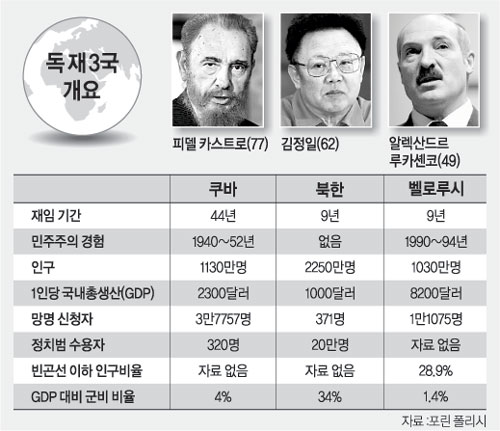 사담 후세인 전 이라크 대통령 생포 이후 다른 독재정권의 운명도 세계인의 관심사로 떠오르고 있다.
미국의 격월간 외교전문지 포린 폴리시 최근호(11·12월호)는 대표적 독재정권인 쿠바, 북한, 벨로루시의 정권 붕괴 이후 시나리오를 소개했다. 다음은 그 내용을 요약한 것이다.
▽북한=김정일(金正日) 국방위원장이 실각한다면 이는 외국 군대의 개입 또는 암살로 인한 것일 가능성이 높다.
김정일 정권의 내부 통제가 워낙 확고해 내부 세력에 의한 정변 가능성은 낮다.
그러나 김 위원장을 대신해 권력을 장악할 세력이 없는데다 민주주의나 시장경제 경험과 기반이 전혀 없어 북한은 오랫동안 무정부 상태를 유지할 것이다.
군부가 권력을 잡을 가능성도 있지만 이들은 국정운영 능력이 없다.
결국 북한은 과도기를 거쳐 한국에 흡수 통일될 것이다. 그러나 남북한간의 엄청난 경제 격차로 인해 진정한 통일이 이뤄지기 까지는 수십년이 걸릴 전망.
북한 주민들이 갖고 있는 한국 정부에 대한 반감도 통일 작업을 어렵게 할 것이다.
▽쿠바=피델 카스트로 쿠바 국가평의회 의장이 축출되면 그의 동생이자 2인자인 라울 카스트로 국가평의회 제1부의장이 차기 지도자로 가장 유력하다.
쿠바가 참여한 각종 전쟁을 승리로 이끈 그는 군부의 강력한 지지를 받고 있다.
그는 퇴역군인들에게 일자리를 주선하는 대신 병력과 군비지출을 축소했다. 농업시장을 자유화하는 등 시장개방에도 긍정적이다. 때문에 라울 카스트로 치하의 쿠바는 중국이나 베트남을 닮을 가능성이 높다.
하지만 반정부 세력은 시장개방 이상의 자유를 요구할 것이고, 국제사회의 개혁 압력도 거셀 것이다. 미국이 쿠바계 미국인을 앞세워 내정에 개입할 경우 반외세 의식을 자극해 정치적 불안을 부추길 수 있다.
▽벨로루시=알렉산드르 루카셴코 대통령이 9년째 장기집권하고 있으며 2006년 대통령 선거가 실시될 예정이다.
벨로루시의 재야 세력은 국정운영 경험이 있고, 서방의 지지를 받고 있다. 유럽안보협력기구(OSCE)는 2001년 대선 당시 야당세력을 규합해 루카셴코 대통령에 맞서도록 도왔다.
미국은 수년간 벨로루시의 민주화운동에 연간 2000만달러(약 240억원)를 지원했다. 올해엔 ‘벨로루시 민주화법’을 제정했고, 2005년까지 4000만달러(약 480억원)를 지원할 계획이다.
그러나 옛 소련연방 해체 이후에도 서방보다는 벨로루시에 막강한 영향력을 미치고 있는 러시아의 선택이 관건이다.
- 김정일 정권 붕괴이후 시나리오 원문 -
The Day After — North Korea: The Hardest Nut
North Korea after Kim Jong Il will be a test case of how well a people worn down by centuries of authoritarian rule and indoctrinated with a xenophobic nationalistic ideology can transform themselves into citizens of the 21st century. Indeed, perhaps none of the world’s oppressed peoples faces the possibility of a more wrenching transition than the North Koreans.
Certainly most of the 22.5 million inhabitants of the Democratic People’s Republic of Korea have never contemplated a change in political leadership or, for that matter, had the luxury of indulging in political thought or action. Living under the scrutiny of a police force whose job it is to keep them isolated from the outside world and from each other, North Koreans are bombarded by propaganda from birth. Articles in the North Korean press often begin with “As Kim Il Sung [or Kim Jong Il] has indicated,” whether the subject is pig farming or foreign policy. Television, radio, school books, posters, movies, and theater all glorify the ruling Kim family and reinforce the principles of juche (a phrase that embodies self-reliance and independence), the two Kims’ ruling ideology. According to its perverted logic, people can be masters of their destiny only if they blindly follow the guidance of the “nerve center of the revolution” (Kim Jong Il), value what is North Korean, shun the temptations of Western culture, and provide for their own welfare—within the boundaries of North Korean socialism—so as not to burden the central government with their problems.
These problems include levels of poverty and malnutrition that make a mockery of even the regime’s surreal slogan, proclaimed in 1991, of “Let’s eat only two meals a day!” Since 1995, the death rate from hunger and disease has surged, with estimates ranging from several hundred thousand to 3 million malnutrition-related deaths.
NORTH KOREA | |
| Leader: |
President Kim Jong II, 62 |
| Years in Power: |
9 |
| Experience with Democracy: |
None |
| Population: |
22.5 million |
| GDP per capita:* |
$1,000 |
| Asylum Applications: ** |
371 |
| Political Prisoners: |
200,000 |
| Population Under Poverty Line: |
N/A |
| Military Expenditures: |
34 percent of GDP |
|
Sources: Amnesty International; Central Intelligence Agency; Migration Policy Institute; United Nations Development Programme; World Bank; The CIA World Factbook; U.N. Human Development Indicators 2003; World Development Indicators 2003 | |
Despite these hardships—or more accurately, because of them—Kim Jong Il’s rule appears secure from domestic threats. His father, Kim Il Sung, ruled for almost 50 years before succumbing to a heart attack in 1994, so the people are used to having a Kim on the throne. No contending power centers or opposition movements can develop, because people spend most of their waking hours in government- and party-controlled organizations. Communication between people and groups—even between Kim’s multiple security services—is severely limited. Radio dials are fixed to the Korean Central Broadcasting Station. Few people have telephones or computers; only a handful of top government officials have access to the Internet. Travel away from one’s home is forbidden except by special permit. Fleeing the country is treason and can be punished by imprisonment or death.
If Kim Jong Il is removed from power, therefore, it will likely be the result of an assassination or foreign military intervention. But immediately after Kim and his regime have been swept from power, North Korean society may well face anarchy. North Koreans are used to having most important life decisions made for them. They are assigned to housing, schools, and jobs. Their participation in the political process is limited to voting for candidates put on the ballot by Kim’s Korean Workers’ Party. They have little experience with entrepreneurship or the market economy, although in order to make up for missing food rations, many have taken to bartering household goods at small markets tolerated by the authorities.
North Korea’s elite of perhaps 1 or 2 million are also unlikely to form the backbone of a stable, post-Kim society. Their positions in the party or government enable them to gain first access to scarce food, housing, and medical care, but their access comes from pleasing their superiors, who in turn must please Kim Jong Il, who holds ultimate life-and-death power over everyone. Freed of Kim’s rule, the elite, already adept at corruption, are likely to get their hands on as much of the national wealth as they can. The North’s handful of economic technocrats lack the scope to employ their knowledge, for fear of contradicting Kim Jong Il’s ever changing, amateurish, and wrong-headed economic ideas. In post-Kim Korea, they will be free to exercise their knowledge, but they will have few resources to work with, and they will have to compete against the more powerful political elite.
The Korean People’s Army, with more than 1 million troops in uniform and another 6 million in reserve, seems to enjoy a symbiotic relationship with Kim Jong Il. Under Kim’s songun, or “military first,” politics, the military has become the dominant political and economic institution, supporting Kim and in return receiving special consideration from him. After his departure, a military junta might be able to take control, perhaps even ruling in the name of the Kim family. But the generals, whom Kim keeps under close surveillance, have shown no inclination to become involved in politics nor have they demonstrated any talent for leading the people or running the economy.
If the military is unable to enforce order after Kim departs, millions of hungry refugees could flee north into China and Russia, south across the demilitarized zone into South Korea, and even chance a boat trip across the sea to join the North Korean community in Japan. North Korea’s neighbors are already making plans to block refugee flows. With South Korea taking the lead, these neighbors can be expected to step in to provide massive amounts of aid and begin repairing North Korea’s decrepit economic infrastructure. But North Korea’s poverty is so great that it will take years for South Korea to transfer sufficient wealth to integrate the two Korean economies. A further economic burden will be imposed by widespread health problems—everything from hepatitis and cholera to rickets and tuberculosis—in the North.
After a transitional period, North Korea will be absorbed into South Korean political and economic institutions, although an inequality in social welfare and status is likely to persist for decades. Consider, also, the difficulties that North Korean defectors have experienced adapting to life in South Korea, including finding and holding on to jobs, managing personal finances, and learning to communicate in South Korea’s cosmopolitan dialect. Fiercely proud, the northerners have also been taught to hate the South Korean authorities, and that hatred will make reunification an even longer and more difficult process.
The Korean people—from both north and south—are hardy and industrious. North Korea is a land rich in minerals such as coal, iron ore, and tungsten, making it well positioned to profit from border trade with China and Russia. Ironically enough, since Korea’s principal trade routes lay north to China, Koreans living in the North were once the travelers and traders of Korean society. Unfortunately, Kim Jong Il and his father may have succeeded all too well in schooling their people in a perverse and unworkable “socialism of our own style.” It is hard to be optimistic about what will happen when, in their weakened mental and physical state, North Koreans must rebuild their country after a half century of neglect. The magnitude of the challenge explains why none of North Korea’s neighbors, much as they dislike the Kim regime, is eager to see it overthrown.

- 관련기사보기
-





- 입력 된 100자 의견이 없습니다.
