


"美 대표단 방북 효과에 회의적"


북한의 핵시설 등을 둘러본 미국 비공식 대표단의 방북은 미 언론에 의해 과장(overplay)됐으며 북핵회담이 처한 교착상태를 바꾸거나 (이르면) 이달 하순으로 예정된 2차 6자회담에서 일정한 역할을 할 것으로도 보이진 않는다고 미국 일간 크리스천 사이언스 모니터(CSM) 인터넷판이 12일 보도했다.
신문은 분석가들의 말을 인용, 미 방북단 성과에 대한 기대감을 조성하려는 북한의 전략과는 달리 방북 결과에 회의적이며 방북이 6자회담에서 주도권을 쥐기 위한 목적으로 이용될 것이라는 미 고위 관리들의 우려 역시 근거없는 것으로 보고 있다고 전했다.
스콧 스나이더 아시아재단 한국지부 대표는 "이번 북한 방문은 미국 정부에 이용 가능한 몇몇 새로운 정보를 제공할 것"이라면서 "하지만 한국이나 중국인들은 북한이 외부인들에게 영변 핵시설 방문을 허용한 것이 (6자회담 등) 공식 절차에 이용될 수 있으리란 생각에 동의하지 않을 것"이라고 지적했다.
실제로 북한의 초청으로 핵시설을 둘러본 비공식 미국 방북단은 핵시설로 측정장비를 갖고 들어가거나 현장의 표본을 갖고 나올 수 없는 등 실질적인 사찰을 수행하지 못했다.
미 상원의원의 한 고위 외교정책 보좌관은 "방북단은 사흘 동안 사찰을 했으나 딱딱한 형식과 철저한 감시가 이뤄지는 가운데 시설을 둘러봤다"면서 "그들이 실제로 무엇을 했겠느냐"고 반문했다.
한편 민주당 간사 조지프 바이든 의원의 보좌관으로 방북한 프랭크 자누지는 방북단이 북한 정부 및 군대 관계자들과 핵문제 뿐만 아니라 인권, 경제 개혁, 납치문제, 죄수 수용소 등 광범위한 분야에 대해 논의했다고 전했다.
<원문보기>
Skepticism swirls around North Korea trip
SEOUL, SOUTH KOREA – A US delegation that included a noted Los Alamos expert is briefing US officials and allies this week regarding its five-day, headline-grabbing trip to North Korea, which included a visit to a nuclear facility that was closed more than a year ago.
Yet despite what appears to be a bid by North Korea to create an atmosphere of great expectations, the trip is unlikely to alter the stalemate over talks or to play a role in negotiations in Beijing later this month, say analysts, some of whom feel the trip was "overplayed" by American media. Even worries expressed by senior US officials that the trip will be used by the North to mollify or gain leverage with other members of the six-party negotiating nations seems unfounded, they argue.
"The trip will provide a few new data points that may be used by the US administration," says Scott Snyder of the Asia Foundation in Seoul. "Yes, the North can say 'we let outsiders visit the Yongbyon facility,' but I don't believe the Chinese or the South Koreans will be willing to go along with the idea that this constitutes something to be used in the official process."
The unofficial US team, invited by North Korea, did not conduct an actual inspection: The delegation was not allowed to bring monitoring equipment into the nuclear facility, which includes a reprocessing plant and a five-megawatt experimental reactor, and were not allowed to bring samples back out.
"They went for three days of inspections, but looked at the plant in the midst of formalities, meetings, and under complete guard," says a senior foreign policy aide to a US Senator. "So what will this actually do? What did they take with them - geiger counters? We know the North has at least two bombs."
While two team members, congressional aides Keith Luse and Frank Januzzi, confirmed the visit to the nuclear complex at Yongbyon, they refused to comment on North Korean claims that they had seen the North's "nuclear deterrent."
The Washington Post reported on Sunday that North Korea might have shown the team reprocessed plutonium.
According to Januzzi, the delegation held wide-ranging talks with military and government officials. "We discussed not only the nuclear issue but also human rights, prison camps, economic reforms, abductions and the military-first policy," he says.
The delegation also included Jack Pritchard, a former State Department official who resigned last year over differences with the White House on the North, and Siegfried Hecker, a former head of the Los Alamos Laboratory in New Mexico, birthplace of the US atomic program.
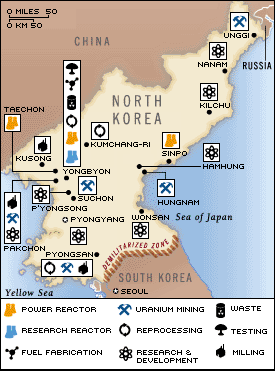
Map source: The Center for Nonproliferation Studies at the Monterey Institute
Some experts speculate the North's invitation was due to frustration with a lack of progress in talks, and is designed to pressure the Bush team. One possible cause for the visit was to allow officials from the isolated North to talk with unofficial American interlocutors.
Yet sources say even these Americans would have described to them "the current reality factor" - that nuclear weapons development will not enhance Pyongyang's security and will continue to keep it isolated.
During much of last year, the North Korean nuclear program was one of the testiest questions facing the Bush administration. The White House has argued that the North must conduct a "complete and verifiable" dismantling of its programs.
Last week, the North stated that it would be "folly" for the US to hope that Pyongyang would follow the recent path of Libya, which has agreed to dismantle its weapons of mass destruction programs.
The stalemate has caused a number of senior advisers to question whether any progress can be made on the North Korean issue without direct talks between Washington and Pyongyang - resulting in clearly defined "sticks and carrots" on a range of additional questions, including fuel, humanitarian aid, and human rights.
More details surrounding the visit are expected to emerge after the team completes its briefings in Washington, including a Senate Foreign Relations Committee hearing Jan. 20.

- 관련기사보기
-





- 입력 된 100자 의견이 없습니다.
