


< NYT>`용산의 운명'


미국의 영향력 있는 일간지 뉴욕 타임스가 31일 미군의 이전 및 인근 부동산 가격 급등 실태를 전하는 서울발 기사를 통해 외세의 점령으로 얼룩진 서울 용산의 역사와 그 장래를 둘러싼 논란을 보도해 원문과 함께 소개한다.
타임스는 주한미군 기지 인근에 건설되는 주상복합 단지 용산 시티 파크 분양에 25만명의 청약자와 60억 달러에 달하는 청약자금이 모여들었다면서 "대개는 전투경찰에 둘러싸인 용산 미군기지가 갑자기 서울에서 가장 투자 열기가 뜨거운 부동산으로 포위되고 있다"고 말했다.
타임스는 "용산은 1882년 청나라 군대 이후 120년 이상 외국군대가 주둔해 왔고 이곳을 지배하는 자가 한국을 지배한다는 속설도 있다"면서 "그러나 오늘날 이곳을 지배하는 자는 서울의 부동산 버블을 이끈 주역들"이라고 꼬집었다.
이 신문은 "시티 파크가 완공될 때쯤인 3년 뒤에는 용산 기지의 미군 7천명 가운데 대부분이 한국과 미국 정부의 합의에 따라 새로 건설되는 평택 기지로 이전해 있을 것"이라고 밝혔다.
뉴욕 타임스는 그러나 30억 달러에 이르는 기지 이전비용을 부담키로 한 과거 한국 정부의 약속에 대해 새로 구성되는 국회가 의문을 제기할 가능성이 있고 미군기지 이전 이후의 개발방안에 대해서도 논란의 소지가 있다고 설명했다.
타임스는 용산기지와 주한미군의 장래에 관해 미국 관계자들 사이에서도 논란이 있다면서 용산기지 이전이 몇년 안에는 힘들 것이라는 한 미군 장교의 말과 이번이야말로 기지가 이전될 것이라는 한반도 전문가의 분석을 동시에 소개했다.
용산기지에 근무중인 한 미군 장교는 "내가 군대에 근무하는 동안에는 용산기지 이전이 이뤄지지 않을 것이라는 데 내 봉급을 걸겠다"면서 "이 문제는 일부에게는 대단한 정치적 선전거리가 되겠지만 앞으로 20년 뒤에도 여전히 계획으로만 남을 것"이라고 주장했다.
반면에 아시아재단의 한국 전문가인 스콧 스나이더씨는 "미군은 이번에는 진짜로 이전하며 그렇지 않다면 아예 한반도를 떠날 것"이라며 "주한 미군 1개 여단은 이라크에 차출됐다 복귀하지 않을 수도 있다"고 지적했다.
뉴욕 타임스는 용산기지의 운명에 관해 자체적인 판단을 내놓지 않았지만 지난해 가을 한국을 방문한 도널드 럼즈펠드 미 국방장관이 기자회견에서 "미국 뉴욕의 센트럴 파크에 외국군대가 주둔하고 있다면 용납할 수 있는 일이겠는가"고 반문했음을 상기시켰다. (konas)
-원문보기-
Neighborhood of U.S. Base Is Hot Real Estate in Korea

Published: May 31, 2004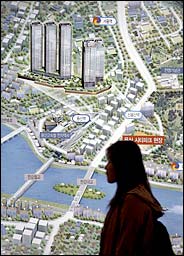 SEOUL, South Korea, May 24 ? "Yongsan, grab it while you can!" beckoned advertisements for apartments bordering the American military headquarters on the Korean peninsula. "Korea's Central Park that will change the map of Seoul!"
Try to grab it they did. About 250,000 potential buyers recently put down a total of $6 billion in deposits, hoping to be chosen for one of the 629 apartments or 141 offices in the City Park towers.
For now, the color of this sprawling downtown base is not park green, but United States Army green. But, suddenly, Seoul's hottest real estate is ringing an American base that in more normal times is ringed with the riot police.
Three years from now, when new owners are to move into the 39-story City Park towers, most of the 7,000 American soldiers are to be moving out, ending the presence of foreign soldiers at Yongsan since 1882.
First, troops of China's Qing dynasty seized this strategic site between the Han River and Korea's royal court. About 25 years later, the occupiers of Yongsan, or Dragon Hill, were Japanese Imperial Army troops who established their military headquarters there. Today's tenants, American troops, live behind cinder block walls topped with barbed wire, esthetic scars that evoke a Fort Leavenworth transplanted from Kansas to Korea. (The American military recently announced that 3,600 American soldiers would move to Iraq from South Korea, reducing the American troop strength here by 10 percent.)
"Whoever rules Yongsan, rules Korea," is the old refrain. In a new twist, today's rulers are players in Seoul's real estate bubble, a commercial frenzy that evokes Tokyo's bubble of the late 1980's.
"We are now the No. 1 destination for development in Seoul," Jeon Young Sik, a 31-year-old marketer for the City Park towers, said in an office festooned with posters for other projects in the long-neglected neighborhood: Megatrium, Yongsan Eclat, Daewoo Trump World III and a tower cluster to rise in the red-light district near the base.
The target for these billions of dollars in investments is a run-down neighborhood of bars, discount shops and apartment buildings built low enough to allow military helicopters to take off and land.
"Compared to the air-brushed advertisements, this site is not that great a location," admitted Kim Su Yeon, whose father put down almost $1 million for a 2,060-square-foot apartment in City Park. "So, yes, I see a big bubble."
Under an agreement near completion, American troops stationed here are to move over the next three years to an expanded base at Pyongtaek, a city 40 miles south.
An American pullout from Yongsan would provide 656 acres of open space to the 10 million residents of Seoul, a city where parks were sacrificed in the rush to create the world's 12th-largest economy. Almost overnight, Seoul, one of Asia's most densely populated cities, could have one of world's largest urban parks.
"Yongsan is 80 percent the size of New York's Central Park," Lee Myung Bak, Seoul's mayor, said, barely suppressing his jubilation in an interview at City Hall. Central Park is 843 acres. "If the U.S. troops are relocated by 2007, it would be the first time in 125 years that the Yongsan site is returned to the people of Korea."
But President Roh Moo Hyun, who survived impeachment to win back full presidential powers on May 14, has described Yongsan as "a symbol of foreign intervention, invasion and dependence."
Now, Koreans ask, who will pay for the move? More than a decade ago, South Korea promised to buy land and invest in facilities and services for a new American headquarters, about $3 billion. But the new, liberal-dominated National Assembly that is to open on June 6 is expected to question the cost.
"Now things have changed in Korea; we are in a position to renegotiate," said Mr. Jeon, the real estate promoter. "We will not accommodate all the U.S. requests unconditionally. We will probably pay for what we can pay for, and the U.S. side will pay for the rest."
Rather than reduce military spending, South Korean defense officials argue, why not raise the money by auctioning off this prime real estate?
"The land must not be sold to developers," said Seo Jae Chul, a director of Green Korea, a major environmental group. "If that happens, it will directly affect the political livelihood of the Roh administration."
Already, new uses are nibbling at the park. South Korean officials have agreed in principle to allow the construction of a United States Embassy on one corner and an English school and a German school on other corners.
Inside Yongsan, some American officers recall that the United States first agreed to leave Yongsan in 1988. The move was delayed because successive South Korean governments never found a suitable site outside Seoul.
"I bet my paycheck that while I am in the Army it will never happen," said one American officer here. "Twenty years from now, I will still be reading about it. It is a great political platform for some people. It's a self-licking ice cream cone."
But Pentagon planners vow that the move from Seoul will not be stopped. To sweeten the shift, the United States has promised to spend $11 billion over three years to upgrade American forces in South Korea.
"We move this time, or we just leave," said Scott Snyder, a Korea specialist who works for The Asia Foundation, a research institute. "A brigade could be relocated to Iraq, and then not come back."
Last fall, South Korean conservatives were startled to hear an American defense secretary suddenly sound as if he were ready to demonstrate for green parks and Korean sovereignty. On a visit here, Secretary of Defense Donald H. Rumsfeld asked at a news conference, "If foreign troops were stationed in New York's Central Park, would it be acceptable to Americans?"

- 관련기사보기
-





- 입력 된 100자 의견이 없습니다.
