


WT "주한미군 일부 이라크.아프간 배치"


유엔司 해체.4성장군 하와이 이전도 검토
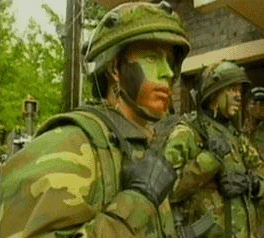 미국은 주한미군 병력 일부를 이라크와 아프가니스탄에 배치하고 서울의 사령부에 배치된 인원 7천명 대부분을 1년 이내에 한강 이남으로 이동시키기 시작할 것이라고 미국 일간 워싱턴타임스 인터넷판이 24일 보도했다.
신문은 이와 함께 미국이 한국내 유엔사령부를 해체하고 4성장군(대장)이 맡아 온 유엔사령부와 한미연합사령부, 주한미군 사령관직을 이보다 낮은 계급의 장성이 맡도록 하는 방안도 검토중이라고 덧붙였다.
이같은 움직임은 한국에서 미 지상군의 개입을 점진적으로 축소시키는 동시에 아시아 안보태세를 해군력에 더욱 의존코자 하는 조치의 일환으로 보인다고 신문은 분석했다.
신문에 따르면 주한미군 감축의 주된 이유는 제2보병사단 병력 1만7천명이 한국 이외의 지역에서 필요하기 때문이다.
이와 관련, 도널드 럼즈펠드 장관은 제2보병사단이 통째로 이라크나 아프가니스탄에 파견되지는 않겠지만 이 사단 소속 병사들을 개별적으로 이라크나 아프가니스탄으로 배치하는 것은 거의 확실하다고 밝힌 바 있다.
한편 미군 소식통들은 서울의 사령부에 배치된 7천명을 한강 이남으로 옮기는 작업이 향후 1년 이내에 시작되고 일부 인원은 미국으로 돌아가게 될 것이라고 말했다고 신문은 전했다.
신문은 이와 함께 한국에서 철수하는 미군 4성장군은 많은 미군 장교들이 지지하는 바대로 하와이의 태평양사령부로 옮겨갈 것이라고 보도했다.
신문은 미군이 한국에 주둔중인 제2보병사단을 다른 목적에 활용하려는 것은 이라크 특정지역의 치안 유지를 위해 1만2천명 규모의 사단급 병력을 파병해 달라는 미국의 요청을 한국이 거절했기 때문이라고 풀이했다
워신턴 타임즈 원문보기
Troops to shift from S. Korea
By Richard Halloran
THE WASHINGTON TIMES
HONOLULU — The United States will reassign some troops from South Korea to Afghanistan and Iraq and shift most of the 7,000 people in its headquarters in Seoul out of the capital beginning within a year, military officials say.
Thought also is being given to disbanding the United Nations headquarters in South Korea and ending the practice of keeping a four-star general in command of operations in the country.
The moves are part of a gradual disengagement of U.S. land forces from Korea and a greater reliance on sea power to maintain the American security posture in Asia.
Secretary of Defense Donald H. Rumsfeld flew through northeastern Asia last week, sprinkling clues about the future of U.S. military dispositions even as he reaffirmed U.S. treaty commitments to South Korea and Japan.
Other officials filled in details.
A primary reason for pulling back from South Korea is that the United States needs the 17,000 soldiers of the 2nd Infantry Division elsewhere. As Mr. Rumsfeld and military leaders have said repeatedly, U.S. forces are stretched thin. The U.S. Army has only 10 divisions and cannot afford to have one tied down in Korea.
Mr. Rumsfeld told the Korean news agency, Yonhap, that the Pentagon has worked out a concept for adjusting force levels in Korea, that discussions have begun with the Korean government and that, within six months, the U.S. Congress will be informed of the plan.
He said the 2nd Division would not be sent to Iraq or Afghanistan but that individual soldiers serving in Korea almost certainly would be assigned to those nations. The division itself will move to posts south of Seoul to be near airfields where soldiers will prepare for contingencies elsewhere in Asia. The 37,000 U.S. troops in Korea today will be cut to an undetermined number.
Military officers said that the Pentagon will shift most of the 7,000 people in its headquarters in Seoul out of the capital, beginning within a year, and that an undisclosed number would be sent back to the United States. They said technology would permit the headquarters to operate with fewer people.
U.S. officials are negotiating terms of the transfer; the United States has long said it would move the headquarters out of Seoul if the Korean government would pay for the transfer.
Korean defense officials have been balking at that. In addition, they are said to fear a loss in operating ability if the U.S. headquarters were moved from its current location across the street from the South Korean Ministry of Defense.
The desire to make other use of the 2nd Division is enhanced by South Korea's rejection of a U.S. request that it send a division of 12,000 soldiers to secure a sector in Iraq.
Seoul will post only 3,000 troops, including the 700 already there. Most will be noncombatants, meaning the United States or another country might have to furnish forces to protect them.
Another reason for drawing down in Korea is the anti-Americanism that has become so widespread that moving U.S. troops out of Seoul and populated areas north of the capital will ease tensions only slightly.
In a discussion of South Korea and North Korea, an American officer said, only half-joking, "Sometimes I wonder which one is really our adversary."
Moreover, President Bush and President Roh Moo-hyun of South Korea disagree on how to dissuade North Korea from acquiring nuclear weapons, despite superficial agreement on tactics. The U.S. president advocates a firm approach, while the South Korean leader would be more accommodating.
Evidently no precise timetable has been set for the changes, but Mr. Rumsfeld suggested that they would be under way in the next five years.
In addition to headquarters and troop movements, U.S. officials have begun to consider disbanding the United Nations headquarters, which has been there since the Korean War of 1950 to 1953.
The Combined Forces Command, which gives the United States operational control over Korean troops, will be dissolved, ending a situation that has long irritated nationalistic Koreans.
Finally, the position of the four-star U.S. Army general, who today commands the U.N. mission, the Combined Forces Command, and U.S. troops, most likely will be abolished in favor of a lower-ranking commander. The four-star flag might be moved to the headquarters of the U.S. Army in the Pacific in Hawaii, as many senior Army officers have advocated.
Mr. Rumsfeld dropped clues about the changes during his flight to Guam, telling the traveling press that the Pentagon has been reviewing force deployments and "we're now at a stage where we can begin discussing [that] with our allies and with Congress."
Aboard the Navy command ship Blue Ridge in Yokosuka, Japan, Mr. Rumsfeld pointed to an increased reliance on sea power, saying: "I think those of you who are serving in the Navy are going to see the responsibilities of the United States Navy increase generally, and increase particularly here."
Addressing Americans in Okinawa, where most U.S. forces in Japan are posted, the defense secretary said, "We've got to continue to pull down deployments."
He said some peacetime overseas deployments would continue but added: "Once they do that job, they ought not to be there any longer." American troops have been in Korea since the Korean War.






- 입력 된 100자 의견이 없습니다.
